After a burst pipe or basement flood in your Troy home, the first call is to your insurer and the second is to your restoration contractor. The third question, almost always, is what is this going to cost. Restoration pricing has shifted in 2026 with new equipment costs, labor rates, and updated Xactimate pricing for Oakland County. This guide breaks down what Troy homeowners actually pay – by water category, by square footage, by affected room type – and what your insurance is likely to cover.
Key Takeaways
- ›Average Troy water damage restoration in 2026: $1,400 (small Cat 1 cleanup) to $9,800 (whole-basement Cat 2 with material removal).
- ›Insurance typically covers sudden, accidental water damage but excludes long-term leaks and flooding from outside the home.
- ›Cat 3 (sewage backup) jobs are 2-3x more expensive than Cat 1 due to mandatory material removal and higher labor PPE requirements.
Cost By Water Category
The IICRC S500 water category determines what the crew can save versus what has to be removed. Each category drives a very different cost structure.
Category 1 (Clean Water): $1,400 – $4,500
Clean water from a broken supply line, an overflowing sink, or a refrigerator water line. Materials are usually salvageable with controlled drying. Typical Troy job: 2-3 days of equipment, no demolition, $1,400 for a small bathroom and $4,500 for a partially-flooded basement.
Category 2 (Gray Water): $2,800 – $7,500
Water from a washing machine, dishwasher, or sustained Cat 1 contamination over 48 hours. Porous materials (carpet pad, drywall paper, insulation) usually need replacement. Typical Troy job: 4-5 days of equipment plus partial demolition, $2,800 for a laundry room and $7,500 for a full-basement event.
Category 3 (Black Water): $5,000 – $14,000
Sewage backup, river or lake flooding, or contaminated ground water. All porous materials must be removed and disposed under PPE protocols. Typical Troy job: 1-2 weeks total including demolition, antimicrobial treatment, and reconstruction. Costs scale fast with affected area.
Cost By Affected Area
Bathroom (50-100 sq ft)
Toilet supply line break or shower pan failure. Cat 1 cleanup with limited demolition. Typical Troy cost: $1,500 – $3,500.
Kitchen (150-250 sq ft)
Dishwasher leak, refrigerator water line, or sink supply line failure. Often involves cabinet inspection and possible toe-kick replacement. Typical Troy cost: $2,800 – $6,500.
Basement, Partial (200-500 sq ft)
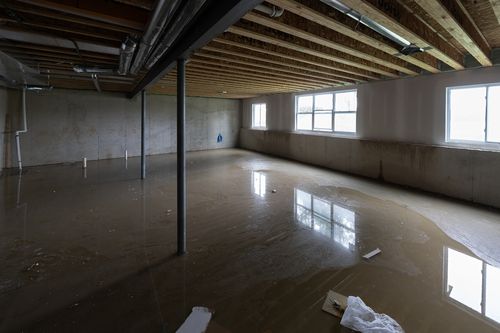
Common scenarios in Troy: sump pump failure, foundation wall seepage, water heater rupture. Typical cost: $3,000 – $8,500 depending on whether finished or unfinished.
Basement, Full Flood (1,000+ sq ft)
Sewage backup or major flooding. Cat 3 protocols required. Typical Troy cost: $9,000 – $16,000 plus reconstruction.
Crawlspace
Often missed in initial assessments. Standing water in a Troy crawlspace requires extraction, vapor barrier replacement, sometimes structural drying of joists. Typical cost: $1,800 – $5,200.
Cost By Square Footage
As a quick benchmark, expect $4 to $7 per square foot of affected area for Cat 1 cleanup, $7 to $12 for Cat 2, and $12 to $25 for Cat 3. These ranges assume Troy-area labor rates and standard insurance documentation. Specialty drying (hardwood, plaster, antiques) can run higher.
What Insurance Covers
Standard homeowners insurance in Michigan covers sudden and accidental water damage, but excludes long-term seepage and surface flooding from outside the home. Per the Insurance Information Institute, water damage and freezing claims account for roughly 24 percent of all homeowners claims, with the average payout near $13,500. Sewage backup is typically excluded unless you carry a separate sewer-backup endorsement (usually $40-$80/year).
Common Add-On Costs Troy Homeowners Forget
- Antimicrobial treatment ($0.30-$0.60 per sq ft, applied as standard practice).
- Content pack-out and storage ($1,200-$3,500 typical).
- HVAC duct cleaning if water reached the system ($400-$900).
- Mold testing if drying drags past 72 hours ($350-$650).
- Reconstruction (drywall, paint, flooring replacement) – separate scope from restoration.
How to Keep Costs Down (Without Cutting Corners)
- Call your restoration contractor before your insurance company – they document the scope properly the first time.
- Photograph every affected area before any equipment arrives.
- Get the scope of work in writing with daily moisture readings.
- Search “Water Damage Restoration Near Me” reviews and verify IICRC certification.
- Avoid the lowest bid – it almost always means short drying time and follow-up mold.
Frequently Asked Questions
1.How much does a typical basement flood cost to restore in Troy?
2.Will my deductible apply?
3.Why is one company quoting half what another quoted?
4.Do I have to use the company my insurer recommends?
5.How long does the average job take in Troy?
Getting an Accurate Troy Estimate
Pristine Clean provides water damage restoration across Troy and the broader Oakland County area with itemized scopes, daily moisture documentation, and direct billing to all major Michigan insurance carriers. The first inspection and estimate are free, and the scope you see is the scope you pay – no surprise add-ons mid-job.